
Crypto payment risk management is the practice of implementing structured processes to monitor, verify, and secure cryptocurrency transactions so businesses avoid financial loss, regulatory penalties, and operational failure. Every business accepting digital assets faces four distinct threat categories: price volatility, fraud, regulatory exposure, and operational breakdown. This guide covers the tools, frameworks, and processing models that financial professionals use to address each one. From Know Your Transaction (KYT) systems built by Chainalysis to the Ethereum Foundation’s Clear Signing standard, the most effective defenses combine technical controls with disciplined workflows.
What are the main risks in accepting crypto payments?
Cryptocurrency transaction safety starts with understanding exactly what can go wrong. The risks fall into four categories, and each one requires a different response.
Volatility risk is the most visible problem. Bitcoin and Ethereum prices can move several percentage points within minutes. A merchant who invoices in crypto and waits too long to convert can lose meaningful margin before the transaction even settles. Short price-lock windows of 10–15 minutes during checkout protect both the buyer and the seller from sudden swings. That window forces a decision before the market moves.

Fraud and illicit fund exposure represent a more serious legal risk. Ransomware proceeds, darknet market funds, and sanctioned wallet addresses all circulate on public blockchains. Receiving a payment from a flagged wallet can trigger regulatory scrutiny even when the merchant had no knowledge of the source. KYT screens wallet addresses using risk categories that include sanctions lists, darknet markets, and fraud exposure. Businesses that skip this step are not just careless. They are exposed.
Regulatory compliance is the third pressure point. Anti-money laundering (AML) obligations apply to crypto just as they do to traditional finance. Sanctions screening, transaction reporting, and customer due diligence are all required in most jurisdictions.
Operational risks round out the picture:
- Delayed block confirmations that leave payment status unresolved
- Underpaid transactions where a customer sends less than the invoice amount
- Reconciliation errors when crypto values are recorded at the wrong exchange rate
- Human error during wallet address entry or transaction approval
Each of these failures is preventable with the right architecture. The following sections explain how.
Which tools help monitor and verify crypto transactions?
Effective digital payment risk assessment depends on real-time visibility into what is happening on the blockchain before and after a transaction settles.
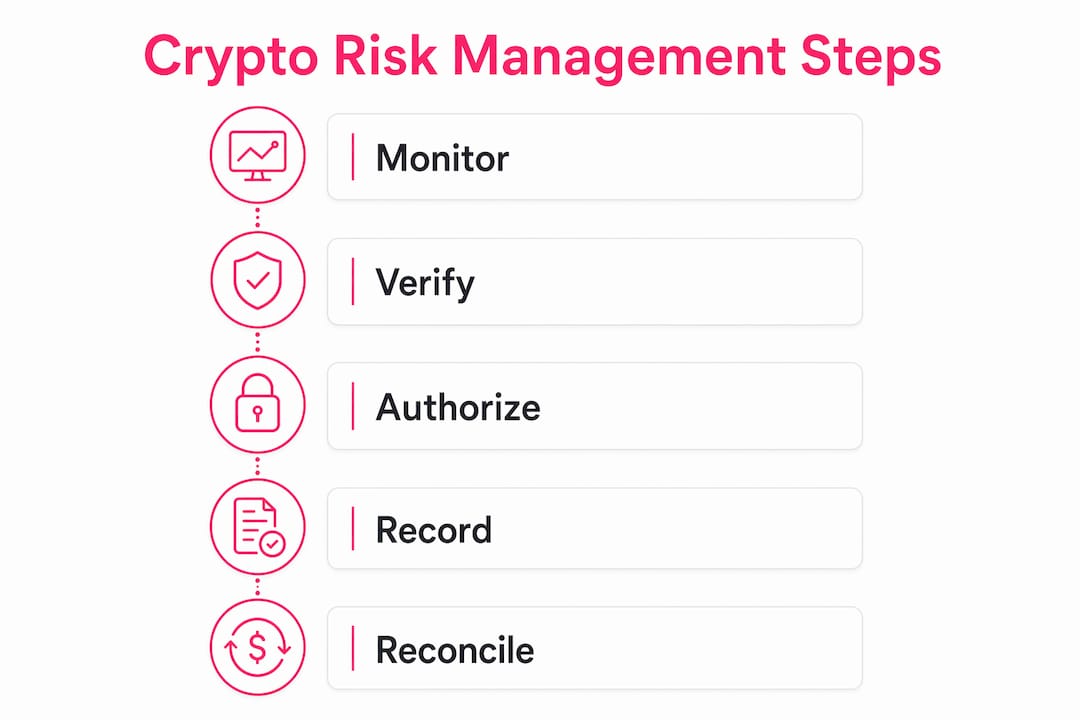
Know your transaction (KYT) systems
KYT is the crypto equivalent of transaction monitoring in traditional banking. Chainalysis built one of the most widely adopted KYT platforms, and its approach is instructive. Blockchain monitoring is proactive by design. The system identifies and flags suspicious payments before final on-chain settlement, giving compliance teams a window to act. KYT assigns risk scores to wallet addresses based on their transaction history and known associations. A wallet linked to a sanctioned entity gets flagged immediately. One with no suspicious history passes through.
On-device transaction verification
Hardware wallets add a physical layer of verification that software alone cannot replicate. Coldcard, a Bitcoin hardware wallet manufacturer, recommends verifying the destination address and amount on the signing device itself before confirming any transaction. Comparing the first and last four characters of the recipient address catches address substitution attacks, where malware replaces a copied address with an attacker’s address. This verification step belongs in every business’s transaction approval workflow, not just individual users’.
The ethereum foundation’s clear signing standard
Blind signing is one of the most exploited vulnerabilities in crypto. A user approves a transaction without seeing a human-readable description of what they are actually authorizing. The Clear Signing standard from the Ethereum Foundation addresses this directly by requiring structured, human-readable transaction descriptions at the point of approval. The initiative reduces the risk of users authorizing malicious contracts they do not understand.
Comparing monitoring approaches
| Approach | Best For | Key Limitation |
|---|---|---|
| KYT (Chainalysis) | AML compliance, sanctions screening | Requires integration and ongoing subscription |
| On-device verification (Coldcard) | Hardware wallet transaction approval | Limited to signing device workflows |
| Clear Signing (Ethereum Foundation) | Smart contract and DeFi transaction safety | Currently Ethereum ecosystem only |
| API rate-lock integrations | Volatility protection at checkout | Does not address fraud or AML |
Pro Tip: Combine KYT screening with on-device verification for high-value transactions. KYT catches bad actors at the network level. Hardware verification catches tampering at the approval level. Neither alone is sufficient.
How do businesses choose secure crypto payment processing models?
Secure crypto payment strategies depend on the processing model a business selects. The two primary options are direct wallet acceptance and third-party payment processors, and each carries a different risk profile.
Direct wallet acceptance gives a business full custody of received funds. The upside is lower fees and no intermediary. The downside is that the business absorbs all compliance obligations, including AML screening, sanctions checks, and tax reporting. This model suits businesses with dedicated compliance infrastructure.
Third-party processors handle compliance, conversion, and custody on behalf of the merchant. Real-time rate calculation refreshed every 10 seconds with 15-minute locks and blockchain monitoring for suspicious wallets are standard features among regulated processors. That combination protects merchants from both volatility and illicit fund exposure without requiring in-house blockchain expertise.
Key practices for either model include:
- Asset and chain allow-lists: Accept only the cryptocurrencies and blockchain networks your compliance team has reviewed. Accepting every token increases exposure to low-liquidity assets and unvetted smart contracts.
- Tiered payment limits: New customers or high-risk locations receive lower transaction limits until they establish a verified history. This limits exposure without blocking legitimate business.
- Pause and escalate workflows: Suspicious transactions above a threshold trigger a manual review rather than automatic processing. This creates a human checkpoint before funds move.
- Crypto-to-fiat conversion timing: Converting immediately at receipt eliminates ongoing price risk. Holding crypto post-payment introduces capital gain and loss tracking obligations.
Pro Tip: If you operate in multiple jurisdictions, choose a processor with built-in sanctions screening across OFAC, EU, and UN lists. Building that compliance layer yourself takes months and requires ongoing maintenance.
What operational practices improve crypto payment reliability?
Managing crypto risks does not end when a payment is initiated. Operational failures most often occur after initiation, including underpaid transactions, delayed confirmations, and reconciliation gaps. Mature payment architectures address each failure mode directly.
Idempotency and retry logic prevent duplicate charges when a network timeout causes a client to resubmit a payment request. An idempotency key ties each payment attempt to a unique identifier. If the same request arrives twice, the system processes it once and returns the same result. This is standard practice in traditional payment APIs and equally necessary in crypto.
Event logging creates an auditable record of every state change in a payment’s lifecycle. When a dispute arises or a reconciliation error surfaces, the log tells you exactly what happened and when. Without it, debugging a failed payment becomes guesswork.
Reconciliation workflows should run on a defined schedule, not ad hoc. Recording each crypto payment at fair market value and tracking capital gains and losses is a compliance requirement in most jurisdictions. The reconciliation burden differs significantly depending on whether a business converts immediately or holds assets.
| Operational Risk | Mitigation Approach | Responsible Party |
|---|---|---|
| Underpaid transactions | Define minimum acceptable payment threshold in API config | Engineering |
| Delayed confirmations | Set confirmation count requirements per asset | Engineering |
| Reconciliation errors | Automated daily reconciliation with exchange rate snapshots | Finance |
| Human approval errors | Hardware verification + Clear Signing workflows | Operations |
| Sanctions exposure | Real-time KYT screening on all incoming addresses | Compliance |
Staff training is the final operational lever. Transaction monitoring tools only work if the people watching them understand what they are seeing. Teams need clear escalation paths, defined response times for flagged transactions, and written policies for communicating payment status to customers. A customer waiting on a delayed confirmation needs a clear update, not silence.
Key takeaways
Effective crypto payment risk management requires combining real-time monitoring, verified transaction approval workflows, and disciplined operational processes to protect against volatility, fraud, and compliance failure.
| Point | Details |
|---|---|
| Use KYT for AML compliance | Chainalysis KYT screens wallet addresses in real time before settlement to block sanctioned or fraudulent funds. |
| Lock exchange rates at checkout | A 10–15 minute price lock protects both merchant and buyer from volatility during the payment window. |
| Verify transactions on the signing device | Comparing address characters on hardware like Coldcard prevents address substitution attacks at the approval step. |
| Apply tiered limits and allow-lists | Restrict accepted assets and set lower limits for new or high-risk customers to control exposure. |
| Automate reconciliation and logging | Daily reconciliation with fair market value snapshots satisfies tax obligations and surfaces errors before they compound. |
The part of crypto risk management most businesses skip
Most businesses I have worked with invest heavily in the front end of crypto risk management. They set up KYT, they choose a regulated processor, they configure their allow-lists. Then they go live and discover that the real problems are operational, not technical.
The failure mode I see most often is what I call the “post-initiation gap.” A payment is sent. The KYT check passes. The exchange rate is locked. And then something goes wrong downstream: a confirmation delay, an underpaid amount, a reconciliation mismatch. The business has no logging, no defined retry logic, and no escalation path. The compliance team did everything right. The engineering team did not build for failure states.
The other gap is human verification. Businesses spend significant budget on software controls and then route high-value approvals through a UI that shows a truncated wallet address. An employee clicks confirm without checking the full address on a hardware device. That is how funds disappear. The Clear Signing initiative from the Ethereum Foundation is a direct response to this problem, and I think it will become a baseline requirement within two years. Businesses that adopt it now are ahead of a compliance curve, not just a UX improvement.
My honest recommendation: treat operational reliability as a compliance function, not an engineering afterthought. The businesses that handle crypto payments well are the ones where finance, compliance, and engineering share ownership of the payment lifecycle from initiation to reconciliation.
— Mervin
How Absolutepay handles risk management by default

Absolutepay is built around the assumption that compliance and operational reliability are not optional features. The platform’s unified API includes real-time exchange rate locking, automated crypto-to-fiat conversion, and built-in compliance checks on every transaction. Businesses that would otherwise spend months building these controls get them on day one. Absolutepay supports over 300 cryptocurrencies and connects to multiple clearing networks for immediate settlement. For teams ready to move beyond manual processes, crypto payouts and treasury management tools handle the full payment lifecycle with the risk controls this guide describes already embedded in the workflow.
FAQ
What is crypto payment risk management?
Crypto payment risk management is the practice of using monitoring tools, verification protocols, and processing controls to protect businesses from volatility, fraud, regulatory penalties, and operational failure when accepting cryptocurrency payments.
How does KYT reduce fraud risk in crypto payments?
KYT systems like those built by Chainalysis screen incoming wallet addresses against sanctions lists, darknet markets, and fraud databases in real time, blocking or flagging suspicious transactions before they settle on-chain.
What is the best way to protect against crypto price volatility?
A 10–15 minute price lock at checkout freezes the exchange rate for the duration of the payment window, protecting both the merchant and the customer from sudden price swings.
What is blind signing and why is it dangerous?
Blind signing occurs when a user approves a crypto transaction without seeing a clear description of what they are authorizing. The Ethereum Foundation’s Clear Signing standard addresses this by requiring human-readable transaction descriptions at the point of approval.
How should businesses record crypto payments for tax purposes?
Each crypto payment should be recorded at its fair market value at the time of receipt. Businesses must also track capital gains and losses, with the compliance burden varying depending on whether they convert immediately or hold the asset.